
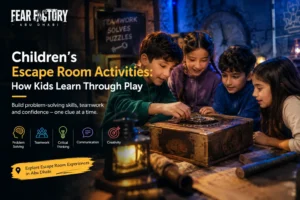
 Anyone who has spent an afternoon with a curious child knows the questions never stop. Why does this open? What happens if I press that? Children learn by exploring, testing ideas and getting things wrong a few times before they get them right.
That is one reason escape rooms appeal to families. A group gets a goal, a set of clues and a time limit, and everyone has to work it out together. It does not replace school or formal learning, but it gives children a way to practise thinking skills while they play.
How Do Children Learn Through Play?
Play-based learning means children pick up skills while doing something they enjoy, rather than being told what to remember. When kids explore, make decisions, solve problems, talk to each other and learn from mistakes, they build habits they use in everyday life.
An escape room brings most of these together. Children search a space, test ideas and discuss what to try next. If a guess is wrong, they try another.
7 Ways Escape Room Activities Help Kids Learn
So, what can children learn from an escape room? Mostly they practise skills they already use, such as thinking, talking and working with others, in a new setting.
1. Problem-Solving Skills
Each puzzle asks children to study the clues, spot a pattern and test a solution. When the first idea fails, they adjust and try again, which is good practice at breaking a big problem into smaller steps.
2. Critical Thinking
Not every object in a room matters. Children have to decide which information is useful and which is a distraction, and explain why they think so.
3. Teamwork and Cooperation
Most puzzles are easier with more than one person. Children learn to share ideas, take turns and let someone else have a go.
4. Communication Skills
Players need to describe what they have found and listen to what others have noticed. A clue is no use if nobody hears about it.
5. Observation and Attention to Detail
A number on a wall, a symbol on a box or an odd object on a shelf may be the key. Rooms reward children who look closely and remember what they saw.
6. Creativity and Flexible Thinking
Two children can approach the same puzzle differently. Hearing another idea teaches kids that there is often more than one way to look at a problem.
7. Confidence and Decision-Making
Solving a small challenge can encourage a quieter child to speak up next time. Groups also have to decide quickly what to try, which builds comfort with making choices.
Why Puzzle Rooms Can Be More Engaging for Kids
A puzzle room is an interactive, themed space where players solve clues and challenges to reach a goal. Many children find these easier to stay focused on than passive entertainment, because they are doing something rather than watching.
The goal is clear, and feedback is immediate: a lock opens, or it does not. Storytelling gives each task a purpose, and curiosity keeps children searching. The activity is also physical as well as mental, since kids move around, handle objects and talk. That is why children puzzle games and room-based activities often hold attention for the whole session.
Are Escape Rooms Suitable for Children?
It depends. Are escape rooms educational for kids? They can be, in the sense that children practise useful skills through play. But suitability varies from one experience to another. Consider:
- The child’s age
- The room’s theme and fear level
- Puzzle difficulty
- Group size
- Venue rules
- How comfortable the child is in enclosed or themed spaces
Parents should check the specific experience and the venue’s current age requirements before booking.
Choosing a Kids-Friendly Escape Room in Abu Dhabi
If you are searching for an escape room in Abu Dhabi, or typing “escape room near me” into your phone, a few questions will narrow the choice:
- Is the theme and scare level right for your child?
- Is the puzzle difficulty suitable for their age?
- What safety information does the venue provide?
- How big can the group be, and what are the booking requirements?
- How long does the session last, and is staff support available?
- Is the location easy to reach?
Think about your child’s personality too. A confident child may enjoy a darker theme, while a more cautious one may prefer something lighter. Indoor activities for kids are always useful in the UAE, especially in the hotter months, and a well-chosen escape room Abu Dhabi families can reach easily is a good option.
Children’s Escape Room Activities at Fear Factory Abu Dhabi
Fear Factory Abu Dhabi offers immersive themed experiences where groups work together to solve puzzles, follow clues and complete challenges. Parents can consider it when looking for family activities, indoor entertainment, group outings, birthday experiences or puzzle-based entertainment in Abu Dhabi.
Some experiences have horror themes, so parents should choose one that suits the children in their group. Check the current requirements for each experience before booking, and contact the team if you have questions.
Why Families Choose Interactive Activities
Families often enjoy activities where children and adults take part together. Everyone contributes, everyone has to communicate, and the whole group shares the result. It also makes for a memorable outing that people talk about afterwards.
If you are planning your next outing, take a look at Fear Factory Abu Dhabi, compare the available experiences and check the details before you book.
Frequently Asked Questions
1. Are escape rooms good for children?
They can be, depending on the child’s age, the theme and the difficulty. Many children enjoy working through puzzles with family or friends. Parents should check the specific experience and the venue’s current age requirements before booking.
2. What do kids learn from escape rooms?
Kids practise problem-solving, teamwork, communication and observation. They learn to follow clues, share ideas, listen to others and make decisions together. These benefits come from playing and will vary from child to child.
3. Are escape rooms educational?
They are educational in a play-based way. Children are not taught a subject, but they use thinking and social skills while solving puzzles. Escape rooms complement formal learning and do not replace it.
4. What skills do children use in puzzle rooms?
Children use logical thinking, attention to detail, memory, creativity and communication. They also practise cooperation and decision-making, because most puzzles are solved faster when the group shares what it finds and agrees on what to try.
5. Is there a children’s escape room in Abu Dhabi?
Fear Factory Abu Dhabi offers immersive escape room experiences for groups and families. Because themes and age requirements differ between experiences, check the current details and choose one suited to your children before booking.